

There is an invisible thread linking Akhenaten’s solar utopia to the technological revolution we are experiencing. Both mark the birth of a parallel reality: a new code capable of redefining the aesthetics, language, and logic of the present, calling into question the established centers of power.
With this article, we propose a historical and sociological analogy to understand Artificial Intelligence beyond technicalities. From Silicon Valley’s “bubble in the desert” to the Amarna revolution, we retrace the history of a utopia that, like every great change, sought to imagine a different order of the world.
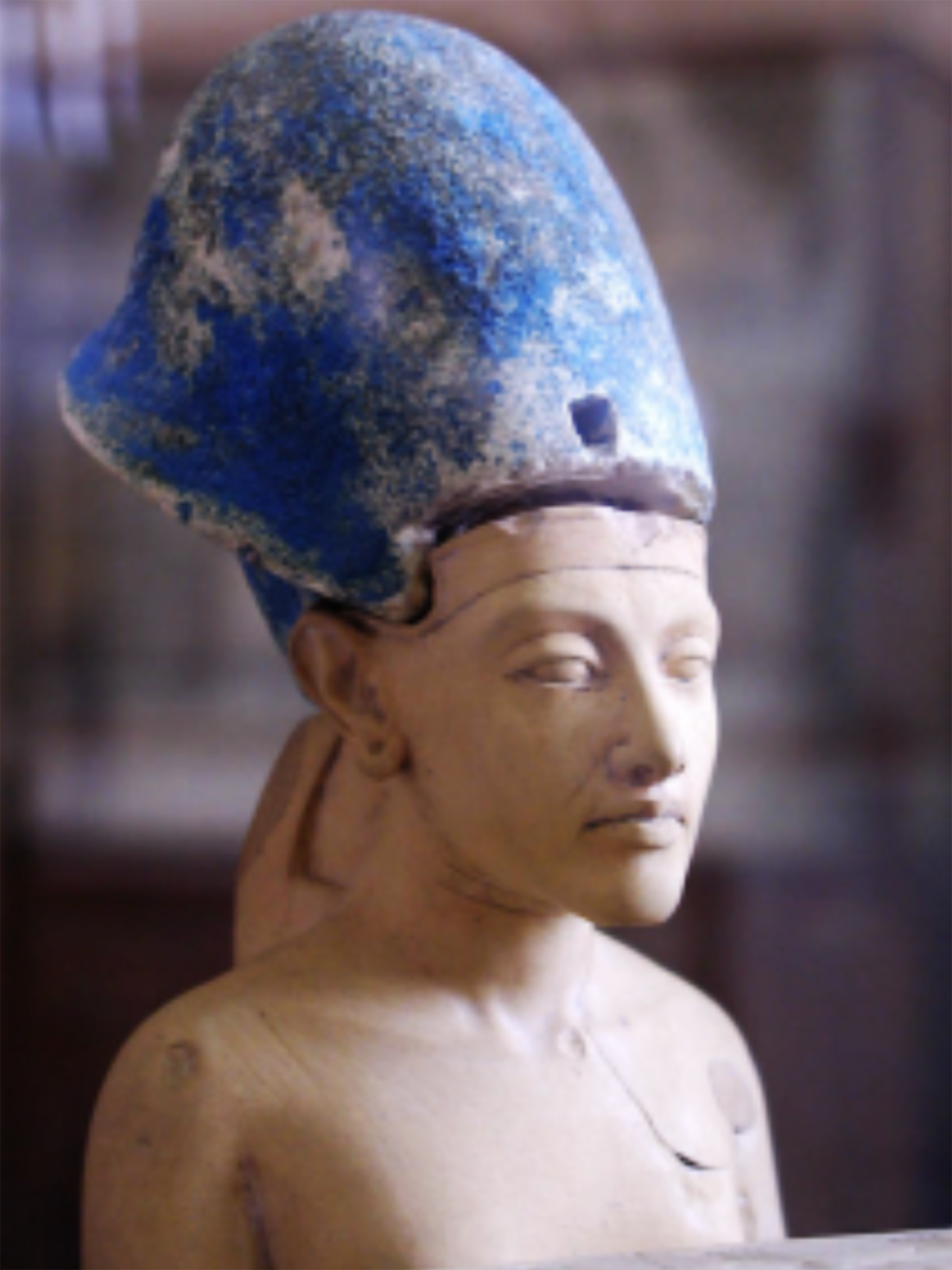
You are beautiful and great (Aten), as you shine high above every land, and your rays embrace the lands as far as the limits you have set, for you are the sun and reach their boundaries and subject them to your beloved son (Akhenaten).
– From the Great Hymn to Aten (1)
Two hundred years of victorious wars had made Egypt the greatest power in the known world, fourteen centuries before the Christian era. The pharaoh ruled an empire that stretched from the waters of the upper Euphrates to the fifth and sixth cataracts of the Nile. Thebes was the most magnificent city of its time; Amun the supreme god, father and guide of the Egyptian pantheon; his priests the richest men on earth, almost as powerful as the pharaoh himself.
And yet, beneath the splendor of that order, a fire was smoldering. For a brief moment in history, the kingdom would see its political, religious, and cultural balance shaken as never before. The man destined to ignite that rupture was Amenhotep IV, whom history would remember by the name of Akhenaten: the Living Spirit of Aten.
Aten, the God of the New World
Amenhotep was born in the enchanting palace of Charuk, in Thebes, around 1395 BC. He was only twelve years old when, upon his father’s death, he ascended the throne under the regency of his mother, Queen Tiye, daughter of the king of Mitanni, Artatama. Around him moved a court of Mitannian and Kassite princesses, some of whom had been part of his father’s harem. Through their stories, the young Amenhotep learned the memories of ancient legends, probably of Indo-European origin, celebrating the glories of a solar God, disk-shaped, with long golden arms, who was light and heat, matter and energy; a god who must have reminded the young Amenhotep of the ancient solar deities of the Heliopolitan tradition, such as Atum/Tem(2), creator of the disk. But even then, in the young pharaoh’s mind, a daring theology was beginning to take shape, one that recognized in the solar disk a self-created and self-sufficient entity, absolutely immaterial and indefinable, immanent in every material existence and, at the same time, permeated by visible matter (the light of the flaming disk) and invisible energy (heat).
Even admitting that Amenhotep was familiar with Indo-Aryan and Heliopolitan symbolism, and perhaps even with Vedic deities such as Surya(3),it is likely that his mystical solar rapture had an even simpler origin. Perhaps it was born in the Egyptian desert. Before the sunrises and sunsets that set the horizon ablaze, in the absolute contrast between light and darkness in a land almost devoid of twilight. It is easy to imagine the young pharaoh absorbed before that vastness, recognizing in the sun not merely a divinity, but the very principle that holds the world together. It was probably there that he resolved to consecrate his life to Aten, the One God, “Heat and Light in the Disk”: a presence that belongs to the world without coinciding with it, visible and yet elusive. In the vision of the man who would become Akhenaten, the solar disk then took on the meaning of a force capable of propelling reality beyond its own limits, toward a new Golden Age. An idea born from the rejection of the present, yet looking simultaneously to the past and the future.
Enlivened by that immense void traversed by light, his mind must inevitably have confronted the gods of Thebes: profoundly human figures, celebrated by a powerful, wealthy, and corrupt clergy, whom the young pharaoh regarded with growing hostility. It was perhaps before those horizons, suspended between the Nile and the desert, that the intuition destined to change the history of Egypt took shape. A new God. A new religion. But above all, a new way of inhabiting the world. Not outside this life or this time, projected toward some further justice or a transcendent realm, but immanent, in harmony with the earth, albeit in a nobler and higher social, political, and philosophical form(4).
The Foundation of Amarna
It is not entirely clear, from a historiographical perspective, whether the intuition of the new cosmogonic solar force arose together with the desire to break free from the old world and the old rites, which found their beating heart in Thebes and in its priesthood devoted to Amun. It seems at least plausible that, in an initial phase, Amenhotep had accepted the idea of a syncretic pantheon, in which the disk of Aten could coexist with the ancient deities. In other words, it seems likely that, before conceiving the rêverie of Amarna, the new pharaoh had sought to transform Thebes. Evidence of this would be the first temple dedicated to the Solar Disk, built within the sacred precinct of Karnak, and his desire to rename the glorious city of his ancestors the “City of the Splendor of Aten.” No less remarkable is the fact that the limestone fragments found at the foot of the temple of Aten bore, alongside the glorified name of Horus(5), those of other gods such as Seth(6) or Wepwawet(7), the jackal-headed god of tradition.
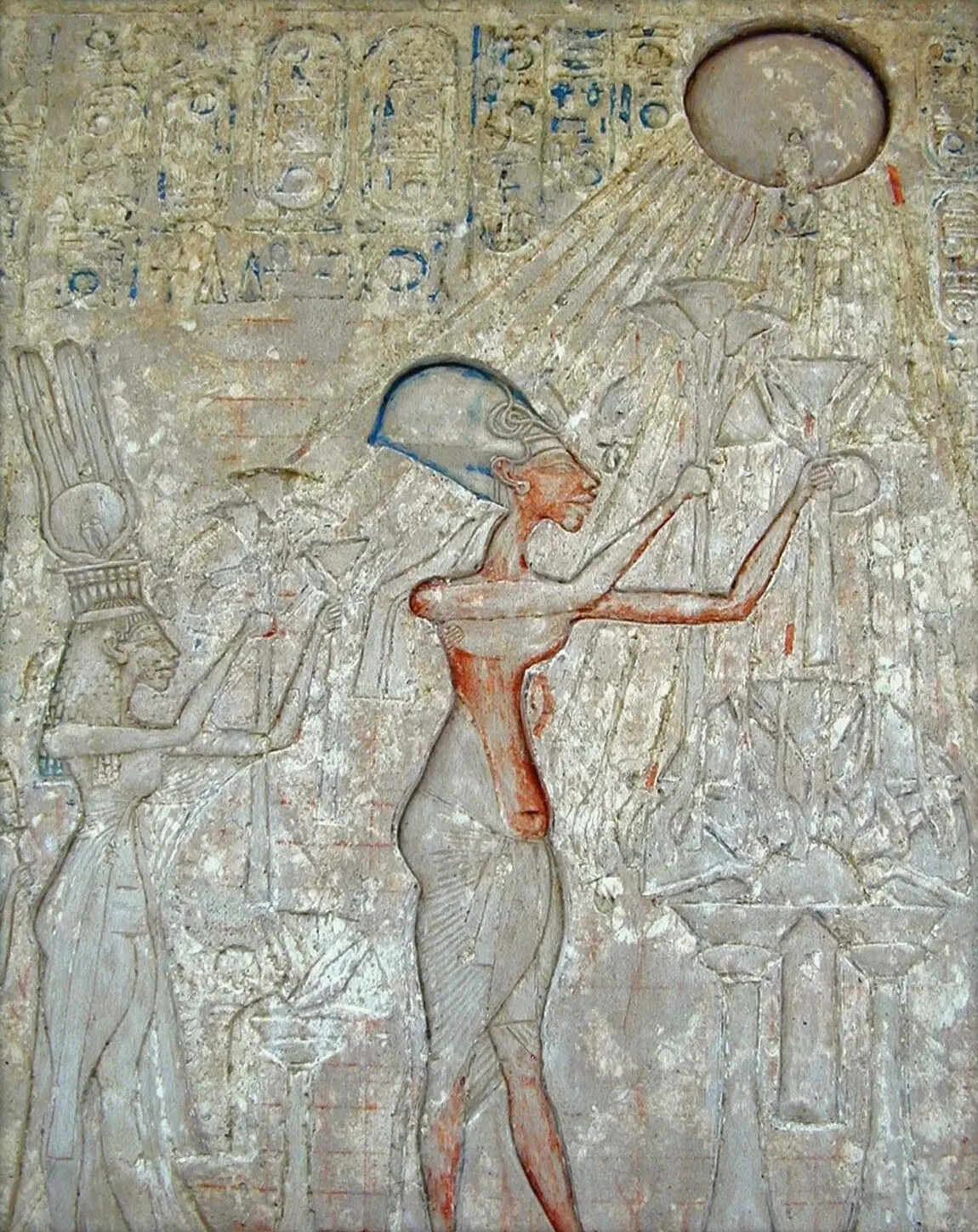
We do not know precisely what actions they took to obstruct the pharaoh. We do know, however, thanks to the inscriptions on the boundary stelae of Tell el-Amarna, that Akhenaten came to regard the priesthood as a profoundly hostile force, capable of threatening the very integrity of the kingdom.
It was then that the conflict became radicalized. The name of Amun was forbidden as a symbol of the priestly State. His images were erased from public and private monuments, even from tombs. Amenhotep changed his name to Akhenaten, “He Who Is Beneficial to Aten.” The lands and wealth of the clergy were confiscated; the great temple of Karnak was closed, and the struggle progressively extended to the other deities of the pantheon, with the exception of the ancient solar gods of Heliopolis.
But in the meantime, something had changed within the pharaoh as well. Years of political tensions and clashes with Theban power had worn down a man whom the sources describe as gentle, contemplative, and little inclined to violence. It was then that the vision of Amarna took shape. We can imagine it as a vision that was both political and spiritual. A place situated in time and, at the same time, at the margins of time. A space capable of escaping the logic of the world without rejecting it, suspended between earthly reality and the revelatory light of Aten. An attempt to build another possibility. The site chosen for this city lay about three hundred kilometers south of present-day Cairo, on the eastern bank of the Nile. A crescent-shaped bay, enclosed between the river and the limestone cliffs of the desert.
It is easy to imagine Akhenaten slowly sailing up the Nile in his felucca. Then, suddenly, that vision: the walls of stone reflecting the midday light and turning pink and violet at sunset; the contrast between the yellow of the desert, the deep blue of the sky, and the blue-gray of the river cutting through the landscape.
According to the boundary stelae, Amarna first appeared to him during a moonlit night.
The pharaoh immediately understood that the place belonged “neither to a god nor to a goddess, neither to a prince nor to a princess.” It was a land that seemed to await its own consecration: new, untouched, innocent. A parallel land. A land without memory. A land still free from the conflicts of the world. Akhenaten immediately consecrated it to Aten, the Disk of Fire, whose essence was light and heat, matter and energy. From that moment on, it would become Akhetaten, the City of the Horizon of the Disk.
Proceeding from north to south, he ordered the great consecrated stelae to be erected along its boundaries. More than simple boundary stones, they were the sign of the fragile border between the world he had chosen to leave behind and the one he wished to build. A world placed alongside the first, without merging with it. A place that evoked the Golden Age of Ra, in a land that had belonged to no one and that, from that moment on, belonged only to Aten (8).
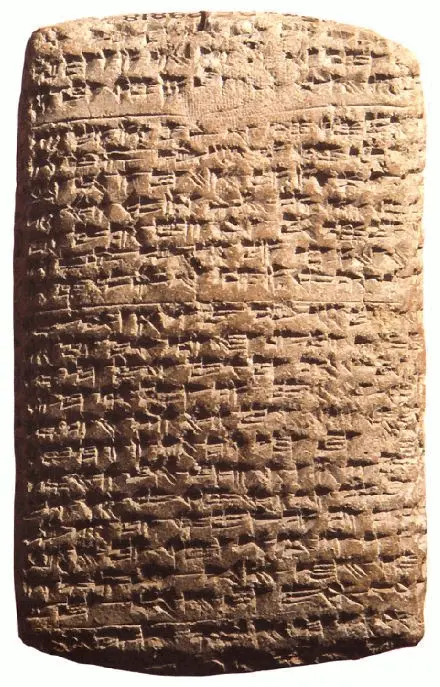
Everything must be for my Father: his hills, his deserts, all his farm animals, all his people, all his cattle, all the things that Aten produces, upon which His rays shine; all the things that are in Akhetaten shall be for my Father, the living Aten, as far as the temple of Aten in the city, forever and ever. All of them are offerings to His spirit. And may His rays be splendid when they receive them (9).
The Dream of Amarna
From the famous Amarna Letters (10), which preserve the pharaoh’s diplomatic correspondence with other kings, vassals, and officials, we know that Akhenaten continued to govern Egypt from his new capital and that he founded at least two other solar cities, one in Syria and the other along the borders with Nubia, at opposite ends of his vast domains. Did he perhaps want to transform the whole of Egypt into a “property of the Sun”? Most likely not. Although he ardently wished to conform the temporal order of things to the cosmic-divine order, he was probably aware of the utopian nature of his endeavor, and his choice not to expand the boundaries of his new city would seem to demonstrate this. Even at the height of his splendor, the pharaoh remained a man at the margins of his own time. He preferred isolation to confrontation, contemplation to war. And the fragile nature of his vision seemed already inscribed in the materials with which the city had been built: rubble and mud bricks hastily assembled, as though time itself were running out.
Perhaps because time really was running out. Because a Golden Age does not easily find a place within an era that is not yet ready to receive it. And yet, despite that fragility, Amarna must have appeared to those who arrived there as a surprisingly harmonious city. Between the desert and the Nile stretched gardens, avenues, and vast open spaces. Along the Royal Road stood the pharaoh’s palace, the lake, the gardens, and the Great Temple of Aten; not far away ran the Road of the High Priest. To the south of the city lay the gardens of Maru-Aten, with pergolas, ponds, and lotus flowers, the earthly image of a paradise that curiously recalls Mount Meru of the Vedic tradition: the cosmic mountain, axis of the universe and threshold of the divine world. The Temple of Aten also broke with tradition. While the sanctuaries of ancient Egypt kept the sacred within their darkest and most hidden chambers, the temple of Amarna opened completely to the light. Vast open-air courtyards led the eye toward the altar, allowing the sun itself to fill the sacred space.
It was an architecture consistent with the new theology: if Aten was light, nothing was to remain in shadow. The royal palace also told the story of this change. Its decorations abandoned the symbolic monumentality of traditional art to make room for a nature observed with astonishing precision: calves leaping through grass dotted with poppies, ducks crossing the marshes, birds and butterflies above the ponds, silver-scaled fish among the rushes, doves flying among more than five hundred palm-shaped columns with gilded capitals.
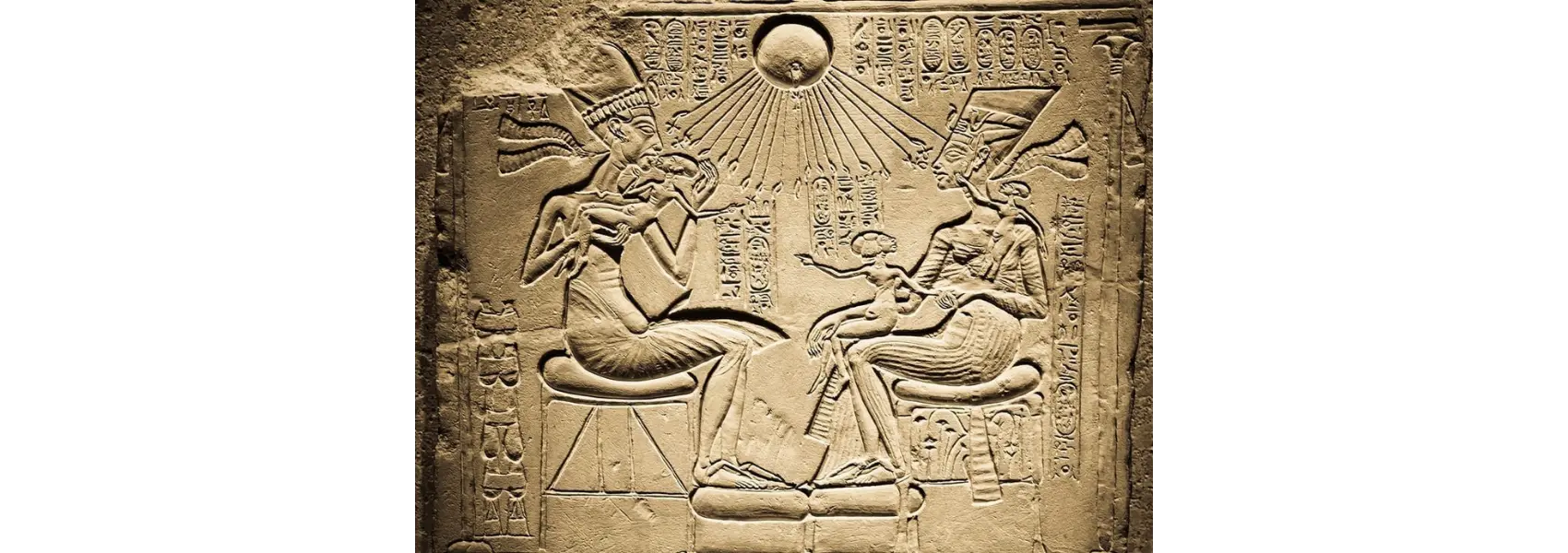
This is what we know today as the Amarna style. A radically new artistic language. And it is precisely here that one of its most surprising aspects appears. Amid this almost photographic naturalism, it is the images of the pharaoh and his family, depicted everywhere, in palaces, houses, and tombs, that seem strangely unsettling. Akhenaten appears with an elongated skull, a pointed chin, a slender neck, and a prominent belly. Features that, over time, have fueled interpretations of every kind, including the most imaginative hypotheses about a supposed “alien” physiology. According to Arthur Weigall, the archaeologist who, more than any other, studied the civilization of Amarna, those distortions did not represent an attempt to reproduce the pharaoh’s body faithfully. Rather, they were a stylistic choice. A deliberate reference to the way rulers of the Age of Ra were depicted in the earliest centuries of Egyptian civilization. As though art itself were participating in Akhenaten’s political and spiritual project: to lead the present back toward a lost Golden Age.
What Remains of the Dream
What remains today of the dream of Amarna?
Much less than its founder would have imagined. Akhenaten never succeeded in seeing his Golden Age realized, not even within the city he had built to embody it. Archaeologists agree that Akhetaten was a paradise above all in the intentions of its creator. Although some celebratory texts suggest an attempt to mitigate traditional punishments, the city remained under the control of a police force, and the workers’ settlement, located several miles east of the capital, although organized according to relatively advanced principles for the time, still resembles a place of forced labor today. The frescoes in the tomb of Mahu, commander of the forces of order, show prisoners being dragged in chains before the authorities. The famous 382 cuneiform tablets of Amarna also present a picture far less ideal than the one imagined by the pharaoh.
The kingdom was shaken by revolts, invasions, and betrayals. From the northern borders spread a vast anti Egyptian movement fueled by rebellious vassal princes and nomadic peoples such as the Sa Gaz of northern Syria and the Habiru of Palestine, supported by the powerful Hittite kingdom and the Amorites. Requests for help from cities loyal to Egypt multiplied. Byblos, Tyre, Jerusalem, Megiddo.
And yet nothing seems to have drawn Akhenaten away from his isolation. There is no evidence that he actually organized a military response to defend the borders of the kingdom. On the contrary, everything suggests that he chose not to intervene, almost as though his distance from the world had by then also become a distance from history. It is likely that this very choice accelerated the decline of his project. Weigall interpreted this rejection of war as a surprising anticipation of the Christian ideal of brotherhood. It is a fascinating interpretation, but not necessarily a convincing one.
More than a form of pacifism, Akhenaten’s attitude seems to have arisen from another conviction: that the cosmic order represented by Aten should find a perfect reflection in the earthly order. From this perspective, the renunciation of war was the natural consequence of a vision of the world in which reality was expected to align spontaneously with the harmony of the cosmos.
The death of the pharaoh, which occurred around 1334 to 1336 BC after seventeen years of reign, marked the end of the Amarna experiment. The young Tutankhamun, probably his son, as the original name Tutankhaten would seem to suggest, returned the capital to Thebes. Akhetaten was abandoned, plundered, and progressively erased. Even the name of Akhenaten suffered the worst fate that ancient Egypt could inflict upon a man: damnatio memoriae. For more than three thousand years, his memory almost entirely disappeared, until the modern rediscovery of the Amarna Letters and the hymns dedicated to Aten.
His body has never been identified with certainty. It is believed, however, that his tomb still lies today in an isolated canyon of Wadi Abu Hasah el Bahri, near Amarna.
What, then, remains of Akhenaten? Much more than the ruins of his city. More than his diplomatic correspondence. More than his lost burial place. What remains is a man who continues to speak to modernity. It is hardly surprising that figures such as Sigmund Freud and Thomas Mann found in his story an inexhaustible source of reflection.
Perhaps no one described him better than Mann himself, in the fourth volume of Joseph and His Brothers:
The young king sought to free the human spirit from the chains of the old zoomorphic gods, to raise it toward the abstract, toward the invisible and the inconceivable (11).
Toward the New Frontiers of a Digital Amarna
And so we come to the crucial point of this historical digression, which in fact originates not so much, or rather not only, from my passion for history and Ancient Egypt, but from an intuition that we wanted to share: are we today immersed in a kind of digital Amarna? Or better still: can we imagine some form of analogy between Akhenaten’s relationship with his era, which we have defined as “tangential” and “parallel to time,” and the current relationship taking shape between the new technologies of artificial intelligence and the temporal and cultural fabric of which they are the infrastructure?
That artificial intelligence is in some way “tangential” to our time is demonstrated, in my view, by a peculiar fact: it touches our present, like Amarna, but orbits around logics of its own. From this perspective, AI is a bubble in the desert, exactly like Amarna, an absolutely geometric and, in certain respects, isolated place, even in relation to our horizon of understanding, in which a pure and ordering logic prevails, that of the algorithm, which as a whole can be compared to that combination of abstract ideas we invoked in our attempt to describe the new “heliocentric” and heretical cosmology of the god of Amarna.
It is therefore “influential” because, like Amarna, it shapes the space and time in which it manifests itself, yet at the same time it remains external, tangential, indeed heretical, since its operational logics are entirely unusual and foreign to the world alongside which it exists. Data centers, neural networks, and computational models constitute an infrastructure that operates alongside our everyday experience and, precisely for this reason, continues to seem partly alien to us. It is perhaps no coincidence that we continue to call it “artificial,” almost as if to emphasize its distance from what we consider properly human.
Like a kind of technological Akhetaten, AI creates around its “eccentric centrality” a new ecosystem, a new code and, perhaps, we might begin to say, a new cult, one that does not reduce itself to the chaos of human life and thought, Thebes, but seeks to order it in the name of a higher logical principle, the sun or algorithm, a single principle that presents itself as the instrument par excellence for managing complexity, represented in the metaphor by the pantheon of the ancient gods of Thebes and their priests.
The solar monotheism of Aten is thus succeeded by an algorithmic monotheism, which removes old certainties while announcing new ones, generating enthusiasm among some, the innovators of Amarna, and fear among the majority, those who remained in Thebes close to the old gods, the not adopters, those who do not welcome the new god or the new technologies.
In Amarna, a generation of pioneers emerges, who in the analogy would be the innovators who, even in our own time, shut themselves away in fortresses such as Silicon Valley (12), surrounded by curiosity, but also by the fear of those who feel excluded from the new capital because they do not understand its symbols, its language, in the analogy neural weights and multilayer networks, or simply because they are afraid to leave the old city and the old gods for the new one.
Amid these tensions, the digital Amarna emerges as the black box of AI: a place in which the future is produced, but which is, in essence, already the future and which, precisely for this reason, remains ultimately inaccessible.
But the analogies do not end here. I realized this while writing about the realism of the “Amarna style”: the calves leaping among the poppies, the wild ducks making their way through the marshes, the birds circling above ponds covered with irises, the fish with silver scales. The Amarna style was revolutionary because it imposed an almost exaggerated realism, a copy so faithful to reality as to become indistinguishable from it, while still emerging from an abstract ideology.
Its hyperreal appearance is that of generative AI, which amazes and unsettles us with its aesthetic verisimilitude, born of a centralized, almost theological order, like that of Aten, which replaces creative and expressive spontaneity, crystallizing every image behind the seal of the concept or algorithm. Like AI images, the artistic representations of Amarna do not arise from lived experience or from a soul, but from the rigid application of an abstract code from which a new aesthetic emerges, one that reproduces and imitates life through the artifice of a logical and geometric language, as perfect as it is, at times, unsettling.
Amarna was a fragile city. Isolated in the desert, distant from the rest of Egypt, fully understood by very few. With the death of its founder, it disappeared almost completely. The myth that had permeated it did not survive the man who had conceived it. Few understood, many were hostile, many, even at the time, feared for their privileges, the priests of Thebes, and Amarna was exclusive: only the chosen children of the sun could enter it, and on this Akhenaten was adamant.
Isolated from its time, while ultimately remaining one of its protagonists, it had remained tangential, parallel, without ever integrating with it. Too perfect to be human, too conceptual, it had risen above time as a kind of prefiguration of the Fields of Aaru (13), a geometric Eden mirroring the perfection of the world beyond, and it had fallen. What, then, will become of the digital Amarna? Will it learn to integrate, will it learn to include, or will it remain like the Temple of Aten, projected toward a geometric and pure space that is entirely unreachable and, ultimately, hostile? (14)
(1) The Hymn to Aten, also known as the Great Hymn to Aten or the Hymn to the Sun, is considered an important theological and literary text of ancient Egypt and one of the earliest examples of a hymn. It is attributed to Pharaoh Akhenaten and offers us a glimpse into the artistic expression of the age of Atenism.
(2) In the Egyptian pantheon, the sun god worshipped in the city of Heliopolis is Atum, often identified with Ra and also known as Tem or Tum. According to the local creation myth, Atum was the first deity to emerge spontaneously from the primordial waters of chaos, subsequently giving rise to the other cosmic elements.
(3) Hindu god of the Sun, he is one of the Adityas, son of Aditi, goddess of the sky. Also present in Buddhist and Jain traditions and worshipped since the Vedic period, he is considered the one who realizes Brahman, the eternal truth.
(4) For a more detailed philological examination of the theological transition and the archaeological finds associated with the cult of Aten, see the collection and studies of the Egyptian Museum of Turin.
(5) God of the sky, war, and justice, usually represented in the form of a falcon, he is the son of Isis and Osiris, whom he avenges after Osiris is killed by Seth. The pharaohs were often described as “living Horuses.”
(6) God of the desert, chaos, and violence, he was represented in human form with the head of a dog. Because of his brutal strength, he was considered the one who disrupted the cosmic order, Ma’at.
(7) An ancient deity of Egyptian mythology whose name means “he who opens the ways.” Represented as a wolf or a canine with gray or black fur, he played the important role of guide both on the battlefield and in the afterlife, protecting the pharaoh and accompanying souls.
(8) Constant updates on the excavations at Amarna and the scientific cataloguing of the clay tablets are available in the archaeological database of the ‘The Oriental Institute’.
(9) Weigall A., Life and Times of Akhnaton, Harmakis, 2019 edition.
(10) The name Amarna Tablets, or Amarna Letters, refers to 382 sun dried clay tablets inscribed in cuneiform script. Of these, around 300 were found in 1887, according to tradition discovered by chance by an Egyptian peasant woman in the area of the ancient capital of Pharaoh Akhenaten, now known as Tell el Amarna.
(11) Mann T., Giuseppe e i suoi fratelli, Milano, Arnoldo Mondadori Editor, 2000.
(12) Another contemporary example of an ideal parallel city is Próspera, the “startup city” located within the territory of Honduras, while not fully being part of it. The enclave is one of the ZEDEs, the Spanish acronym for “Zone for Employment and Economic Development,” established by the Central American country to encourage growth and innovation. The heart of this city is located in Roatán, an island surrounded by the crystal clear waters of the Caribbean, where numerous resorts coexist with the local population. An enormous building towers over the center of this city of the future: Duna Residences, which combines apartments, offices, coworking spaces, and shops. The building is the symbol of Próspera’s special status, which enjoys its own regulations and a tax regime favorable to businesses. One of these is Minicircle, which, at its clinic, offers an experimental gene therapy that promises almost eternal youth.
(13) In Egyptian religion, the Fields of Aaru, or “Fields of Reeds,” are the dwelling place of the dead. Located in the eastern sky, where the sun rises, they were described as an infinite expanse of water until the New Kingdom, when they began to be represented as fields covered with crops, which the dead plowed, sowed, and harvested.
(14) Opinions on the future of AI, between Amarnian exclusion and proprietary control, remain divided today. The risk of an exclusive AI that fails to integrate and therefore remains “tangential” to the world finds its counterpoint in the fears of those who believe that AI will instead tend to integrate us and possess us. From this perspective, AI will not be a separate realm, like Akhenaten’s Amarna, but a kind of Benthamite Panopticon, in which the owners of the new realm could become the custodians of knowledge, eventually managing it in their own exclusive interest, occupying our society and its spaces from within and subjugating human intelligences.